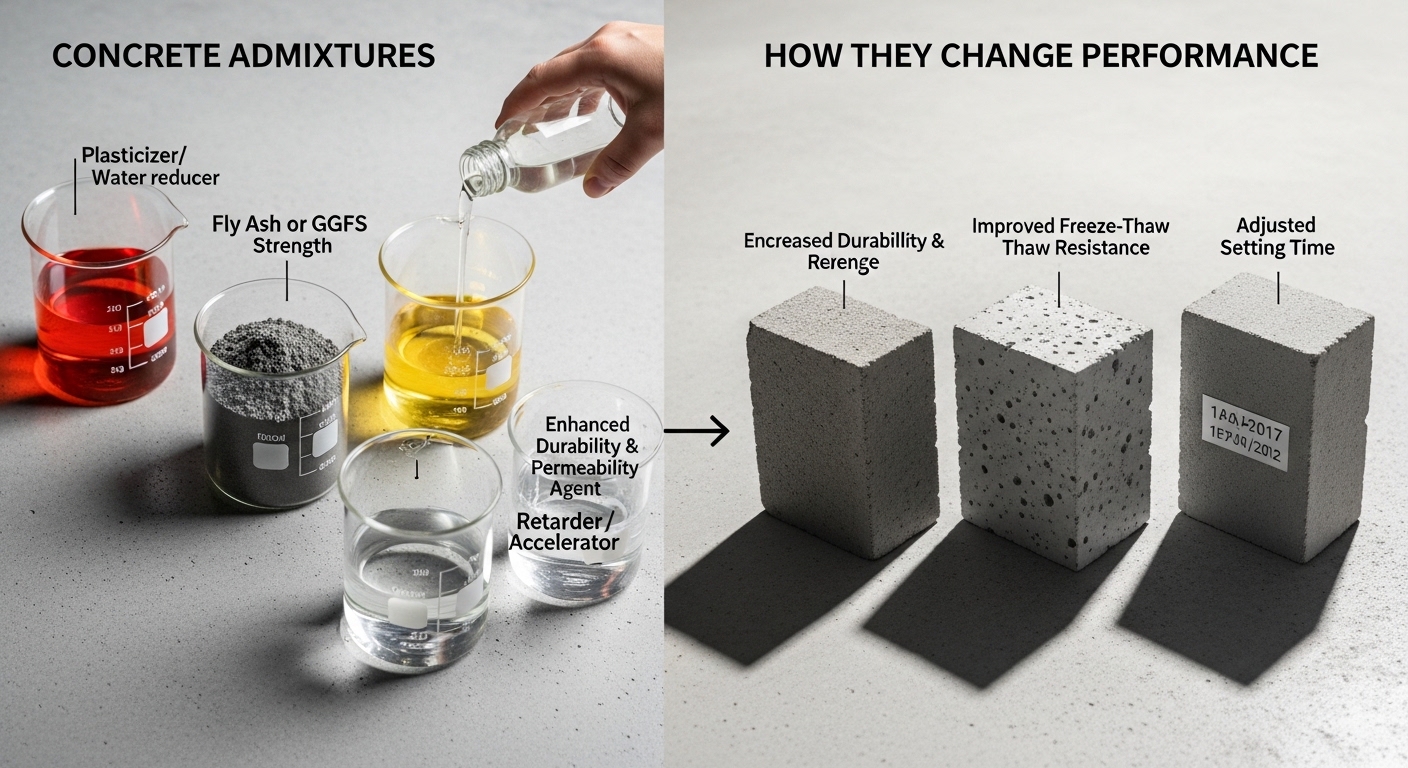
What are Concrete Admixtures and How Do They Change Performance?
What are Concrete Admixtures and How Do They Change Performance?: Concrete is a versatile material, but in its basic form—cement, water, and aggregates—it has limitations. To overcome these limitations, adapt to specific environmental conditions, or enhance workability, engineers use concrete admixtures.
Admixtures are functional ingredients added to the concrete mix immediately before or during mixing. They are not simply fillers; they are engineered chemicals designed to alter the properties of concrete in both its plastic (wet) and hardened states. This article explores the different types of admixtures and how they revolutionize concrete performance.
What are Concrete Admixtures?
According to ASTM C494, a concrete admixture is defined as a material other than water, aggregates, hydraulic cement, and fiber reinforcement, used as an ingredient of concrete or mortar and added to the batch immediately before or during its mixing.
While traditionally used in small quantities, admixtures have a profound impact on the final product. They allow concrete to be pumped to great heights, set rapidly in cold weather, remain workable in high heat, or achieve immense strength for industrial applications.
Types of Concrete Admixtures and Their Functions
Admixtures are generally classified by their function. Here are the primary types used in modern construction:
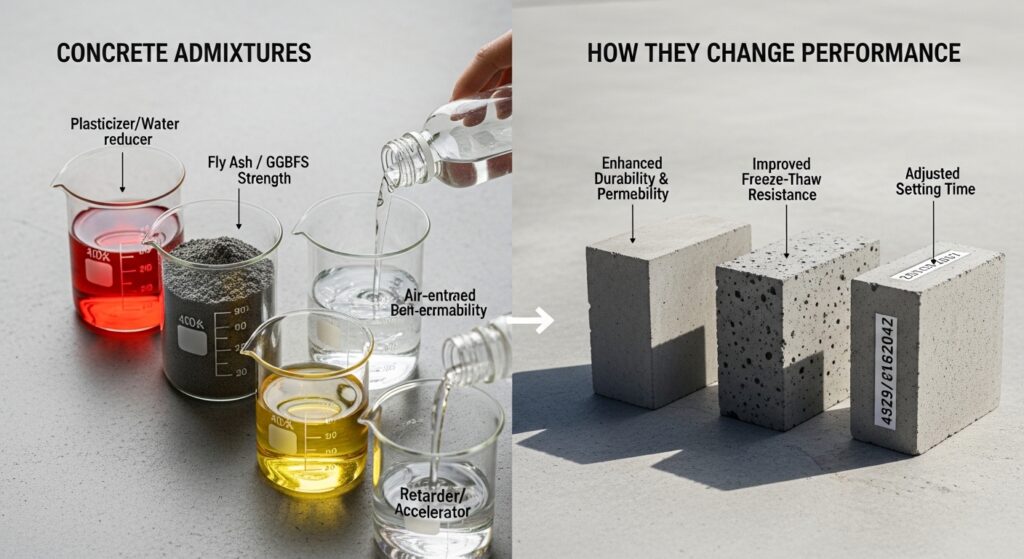
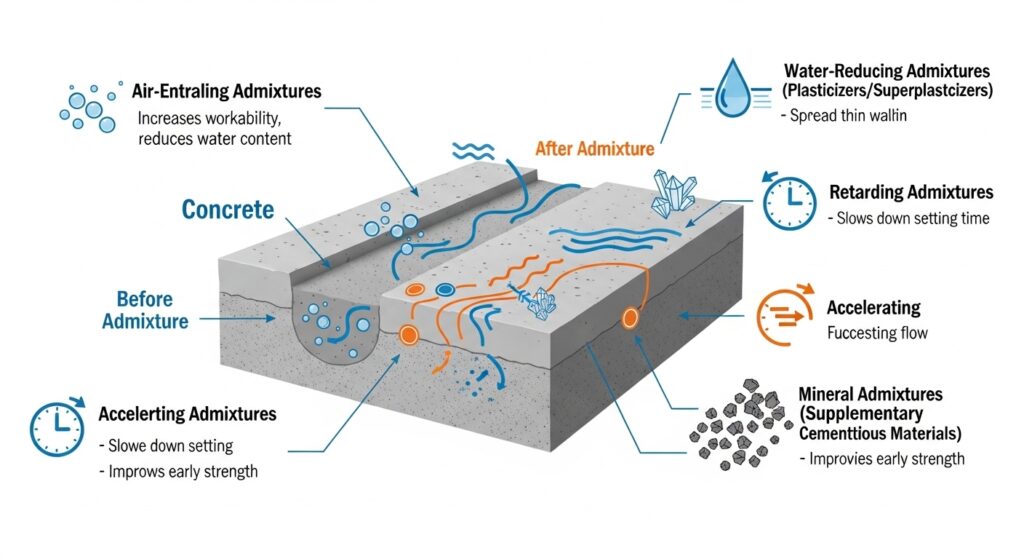
1. Water-Reducing Admixtures (Plasticizers)
These are perhaps the most common admixtures used today. Their purpose is to reduce the amount of water required to achieve a certain workability (slump) of concrete.
- How They Work: They disperse the cement particles, making the mix more fluid without adding extra water.
- Performance Change: By reducing the water-cement ratio ($w/c$), they significantly increase the compressive strength and reduce permeability, leading to more durable concrete.
2. High-Range Water-Reducers (Superplasticizers)
These are more advanced versions of plasticizers.
- Performance Change: They can reduce water content by over 30%. They are essential for producing Self-Consolidating Concrete (SCC), which flows into intricate forms without vibration.
3. Set-Retarding Admixtures
Used primarily in hot weather or when concrete must be transported over long distances.
- Performance Change: They delay the chemical reaction of hydration, slowing down the setting time of the concrete. This prevents the concrete from hardening before it can be properly placed and finished.
4. Set-Accelerating Admixtures
The opposite of retarders, these are crucial for cold-weather concreting.
- Performance Change: They speed up the initial setting time and increase the rate of early strength development. This allows for earlier formwork removal and faster project completion.
5. Air-Entraining Admixtures
These admixtures introduce microscopic air bubbles into the concrete mixture.
- Performance Change: This is vital for concrete exposed to freeze-thaw cycles. The tiny bubbles provide space for water to expand when it freezes, preventing the concrete from cracking and scaling.
Enhancing Durability and Specialty Performance
Beyond basic setting and workability, admixtures can provide specialized protection.
Corrosion Inhibitors
For reinforced concrete structures near saltwater or exposed to de-icing salts, corrosion inhibitors are essential.
- Performance Change: They form a protective film on the steel reinforcement, significantly extending the life of the structure by delaying the onset of rust.
Waterproofing Admixtures (Permeability Reducers)
These chemicals reduce the water absorption of concrete.
- Performance Change: They make the concrete less porous, preventing the penetration of water, oils, and other chemicals that cause degradation.
Shrinkage-Reducing Admixtures
Concrete naturally shrinks as it cures, which causes cracking.
- Performance Change: These admixtures reduce the surface tension of water within the concrete pores, minimizing drying shrinkage and cracking.
Benefits of Using Admixtures in Construction
Incorporating admixtures into a concrete mix provides several crucial benefits:
- Improved Workability: Allows concrete to be placed in difficult-to-reach areas or pumped long distances without compromising strength.
- Increased Strength: By lowering the water content, stronger, more durable concrete is achieved.
- Enhanced Durability: Protects concrete from harsh environmental conditions like freezing, chemical attacks, or saltwater exposure.
- Cost Savings: While admixtures cost money, they can reduce the amount of cement needed for a specific strength, or reduce labor time through faster setting or easier placing.
- Environmental Sustainability: High-performance mixtures often allow for a lower carbon footprint by reducing the amount of cement clinker required.
Challenges and Considerations
While beneficial, admixtures must be used correctly.
- Dosage: Overdosing can have disastrous effects, such as excessive retarding (concrete never sets) or loss of air entrainment.
- Compatibility: Not all admixtures work well together. Engineers must test the specific combination of cement, aggregates, and admixtures to ensure compatibility.
- Mixing Time: Some admixtures require specific mixing times to disperse correctly through the batch.
Conclusion
Concrete admixtures are indispensable tools in modern engineering. They transform concrete from a simple mixture into a customized, high-performance material tailored to the specific needs of any project. From bridges that withstand freezing temperatures to high-rise buildings requiring specialized pumping, admixtures make it possible to build safer, stronger, and more durable infrastructure.