The Science of Concrete Mix Design: A Beginner’s Guide to Proportions
The Science of Concrete Mix Design: Concrete is often mistaken for a simple mixture of “mud” that hardens over time. In reality, concrete is a sophisticated chemical composite. Concrete Mix Design is the process of selecting suitable ingredients and determining their relative quantities to produce concrete of maximum economy and required strength.
Whether you are pouring a small garden path or a massive commercial foundation, understanding the “Golden Ratio” of concrete is the difference between a structure that lasts a century and one that crumbles in five years.
1. The Four Essential Components
To design a perfect mix, you must understand the role of each “player” in the bucket:
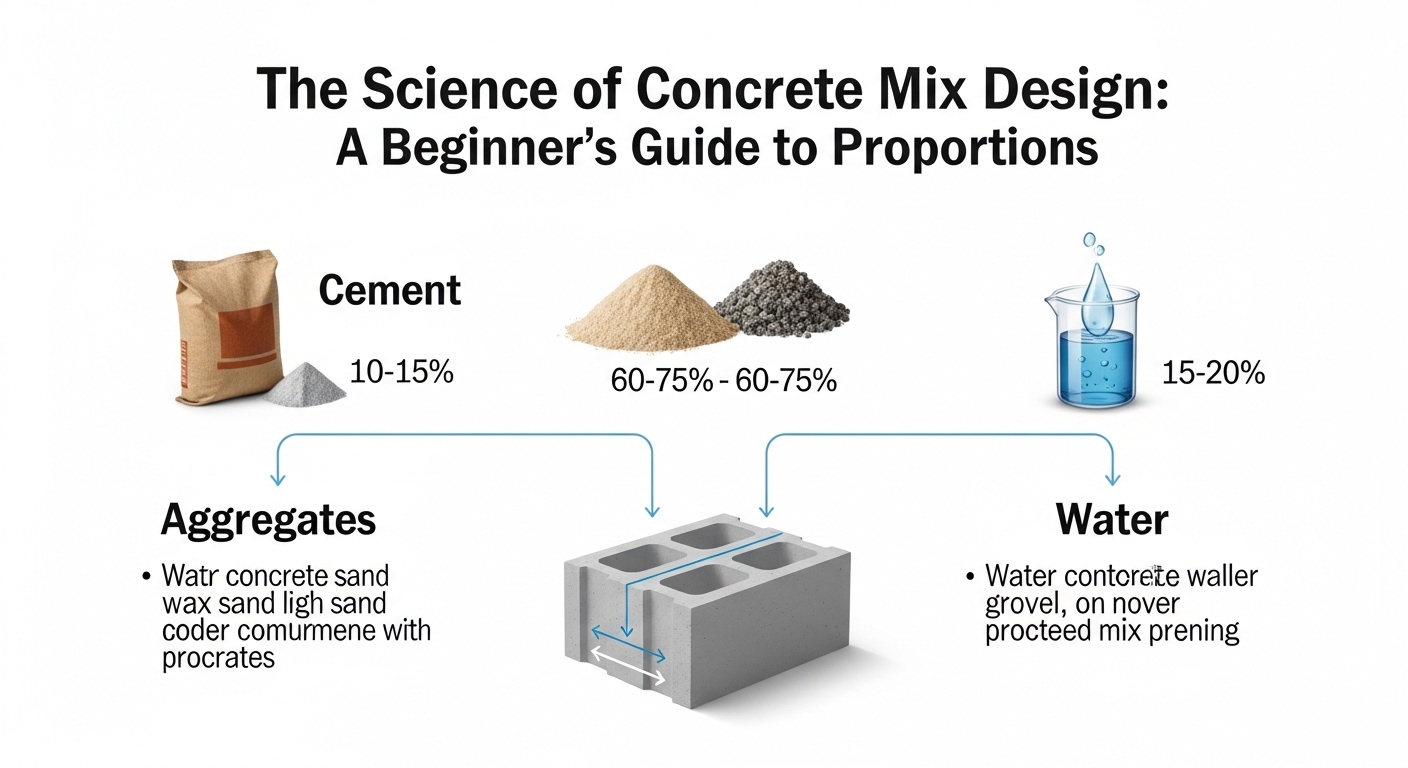
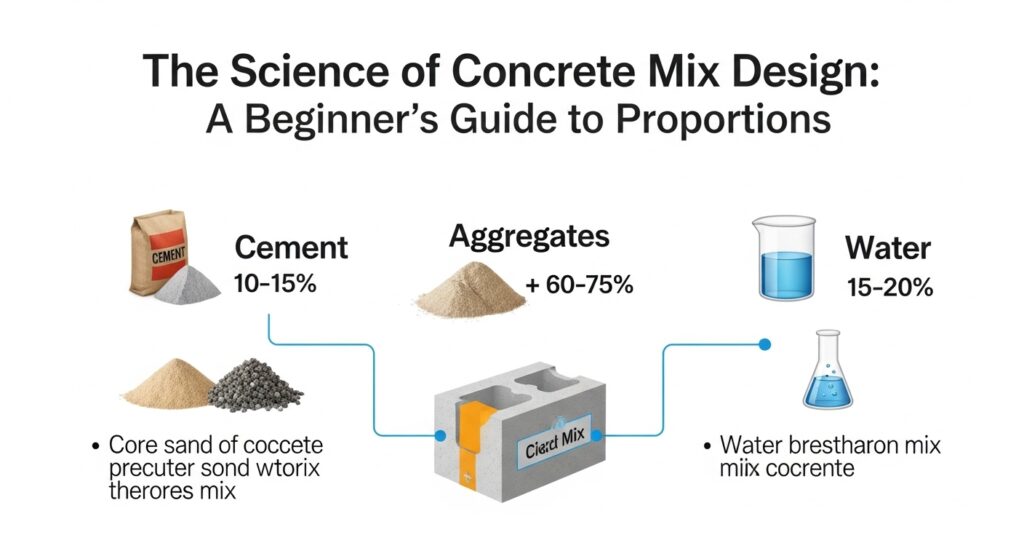
- Cement: The “glue” (binder) that reacts with water.
- Water: The “activator” that starts the chemical process called hydration.
- Aggregates (Gravel & Sand): The “skeleton” (filler) that provides bulk and resistance to wear.
- Air: The “cushion” that helps concrete survive freezing temperatures.
2. The Water-Cement Ratio ($w/c$): The Most Important Number
If you remember only one thing about concrete technology, let it be the Water-Cement Ratio.
The $w/c$ ratio is calculated by dividing the weight of the water by the weight of the cement.
- Low Ratio (0.40 – 0.45): Produces high-strength, low-permeability concrete. It is harder to work with (stiff) but incredibly durable.
- High Ratio (0.60+): Produces “soupy” concrete that is easy to pour but will be weak, porous, and prone to extreme cracking.
3. The Standard 1-2-3 Rule for DIYers
For general residential projects where a lab-tested design isn’t required, many professionals use the 1:2:3 Proportion Rule (by volume):
- 1 Part Cement
- 2 Parts Sand
- 3 Parts Coarse Aggregate (Gravel)
This usually yields a strength of approximately 3,000 PSI, which is perfect for sidewalks and small pads.
4. The Steps of Professional Mix Design
Step A: Target Strength Selection
Engineers design for a “Target Mean Strength” which is slightly higher than the required strength to account for variations in materials and weather.
Step B: Selection of Water Content
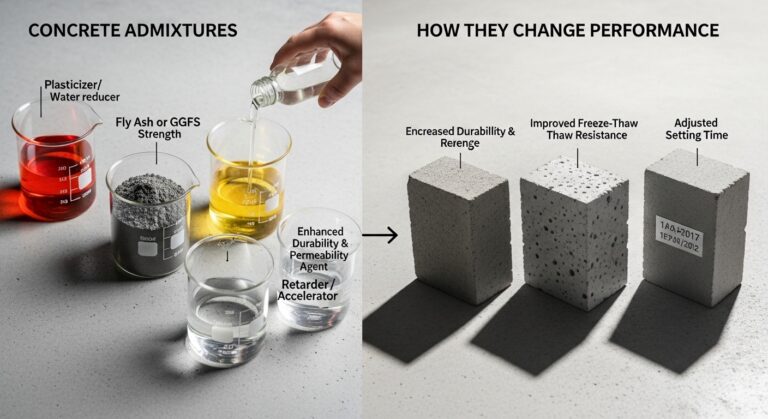
This is based on the desired slump (workability). If the concrete needs to be pumped through a long hose, it needs more flowability, often achieved using superplasticizers rather than just adding water.
Step C: Aggregate Proportioning
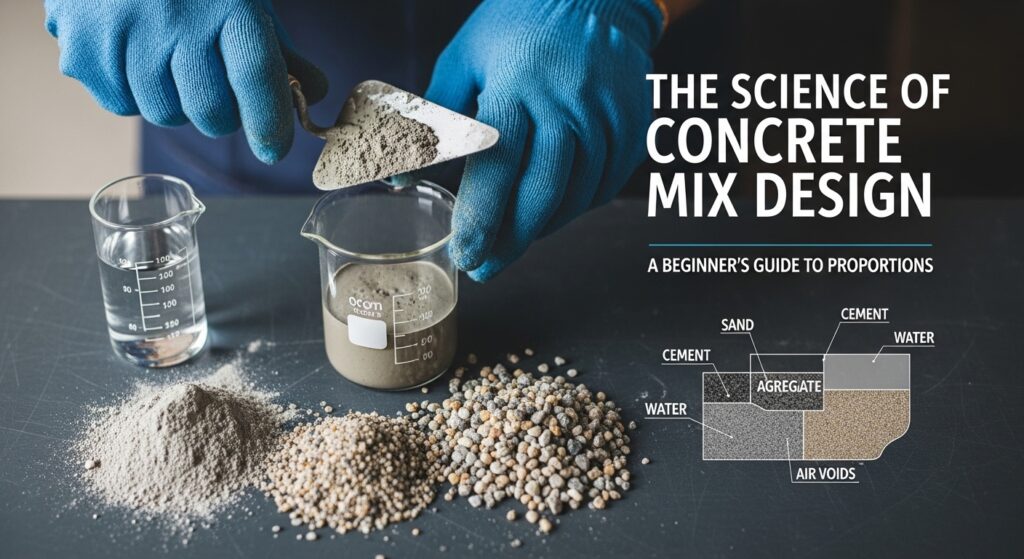
You want a mix of different sizes. If all your rocks are the same size, there will be huge “voids” (air pockets) between them. Using a mix of sand (fine) and gravel (coarse) ensures the sand fills the gaps between the rocks, creating a dense, solid mass.
5. Why “Trial Batches” Matter
In professional Commercial & Industrial work, you never just trust the math. You create a “Trial Batch.”
- Mix a small amount of your designed recipe.
- Test the Slump.
- Cast test cylinders.
- Break them in a lab at 7 days and 28 days.
- Adjust the recipe if the strength is too low.
6. Common Mix Design Mistakes
- Adding “Just a Little More” Water: This is the #1 cause of concrete failure. Every extra gallon of water added to a cubic yard of concrete can reduce the strength by 200–300 PSI.
- Dirty Aggregates: If your sand or gravel has clay or silt in it, the cement won’t bond to the rocks, leading to “scaling” or peeling surfaces.
- Improper Mixing Time: Under-mixing leaves “dry pockets” of cement. Over-mixing can break down the aggregates and cause the mix to get too hot.
Conclusion
Concrete Mix Design is a balance between Workability, Strength, Durability, and Economy. While the 1-2-3 rule works for your backyard, large-scale infrastructure relies on the precise calculation of the water-cement ratio and the chemical interaction of admixtures.
By mastering the mix, you ensure that the concrete you pour today stands as a testament to quality for decades to come.